Two semis, two conservatories, two quotes
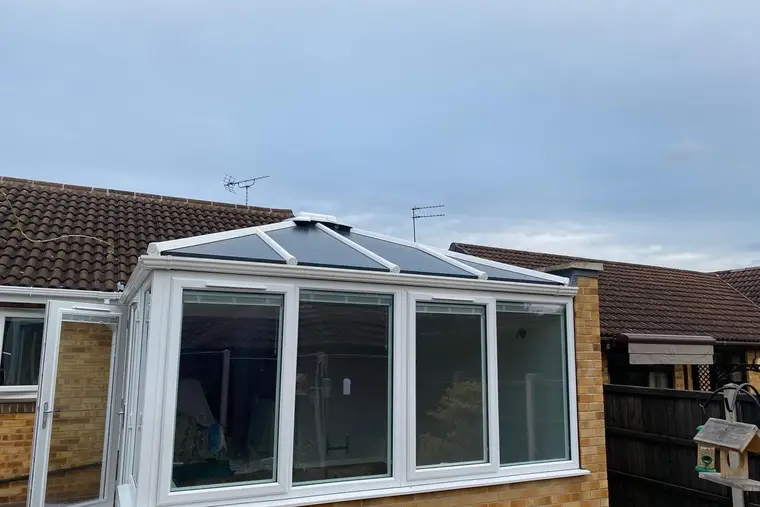
Picture a pair of 1990s semis. Number 12 and Number 14 each had the same 4 m by 4 m Edwardian conservatory put on by the same builder in the same summer. Both have a 16 mm polycarbonate roof, about 17 m² of it. Both rooms sit empty from November to March and bake in July.
This is an illustration, not a customer story. The houses are made up. The prices, U-values and energy figures are real, and you can check every one with the sums further down.
Number 12 asks for a lightweight tiled roof. Number 14 asks us for insulated panels. Here is what arrives in each letterbox.
| Number 14: insulated panels | Number 12: lightweight tiled roof | |
|---|---|---|
| Fitted price | £4,200 to £4,950 | £10,050 to £14,750 |
| Days with trades on site | 1 to 2 | 3 to 5 |
| Roof frame | Existing glazing bars kept | Stripped out and rebuilt |
| Ceiling inside | White panel underside, finished on the day | Boarded, plastered, dried, then painted |
| Scaffold | Not needed on most single storey roofs | Usually needed |
| U-value of the new roof | About 0.43 W/m²K | About 0.15 W/m²K |
| Council sign off | Yes, in most cases | Yes, in most cases |
Same room, same street. Number 12's quote is between £5,850 and £9,800 higher. Everything below explains where that money goes, and whether it comes back.
Run the same test on your own conservatory
Set your floor size and shape below. Both figures are fitted prices, with the old roof removed and building control included. The gap between them is what choosing panels would leave in your account.
Stays in your pocket
The tiled side is drawn from what UK installers were publicly charging in 2026, which puts a 3 m square lean-to at roughly £6,000 to £9,000 and a large Edwardian at £15,900 to £22,900. The panel side is our own price list.
The gap at every size
The difference grows as the roof gets bigger. A tiled roof is costed like building a small room on top of your walls. A panel roof is costed like changing what sits inside a frame you already own.
| Conservatory | Insulated panels | Lightweight tiled roof | Difference |
|---|---|---|---|
| Small, 0 to 12 m² | £3,200 to £3,800 | £6,350 to £9,550 | £2,550 to £6,350 |
| Medium, 12 to 25 m² | £4,200 to £4,950 | £10,050 to £14,750 | £5,100 to £10,550 |
| Large, 25 m² and over | £5,800 to £6,850 | £15,900 to £22,900 | £9,050 to £17,100 |
On a small lean-to the tiled route costs about twice as much. On a large Edwardian of about 28 m², panels come in at £5,800 to £6,850 against £15,900 to £22,900 tiled, close to three times the price at the top end.
Where Number 12's extra money goes
The tiles are not the expensive part. The cost is in everything a tiled roof needs underneath and around them. Follow Number 12's job week by week and it adds up quickly.
A new roof frame
Number 12's polycarbonate comes off, and so do the glazing bars, the ridge and the box gutter. A new structure goes up in their place: a ring beam sitting on the window frames, rafters, battens, a breathable membrane and insulation boards, and only then the tiles. Every one of those layers is bought, carried in and fixed by hand.
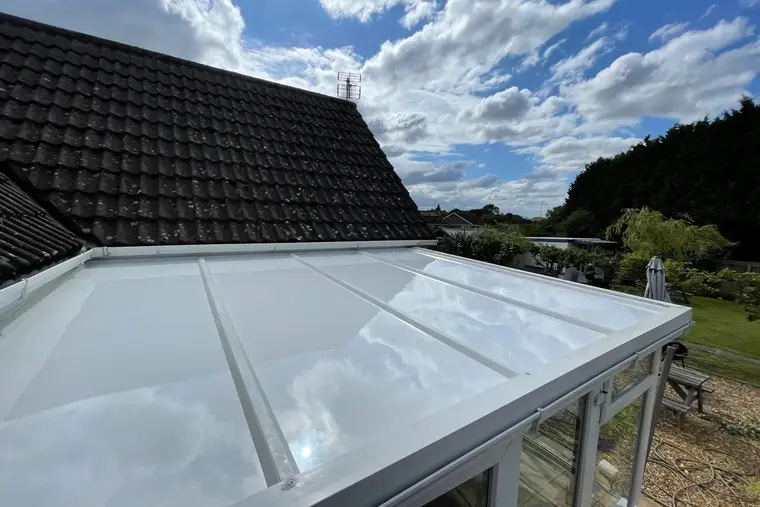
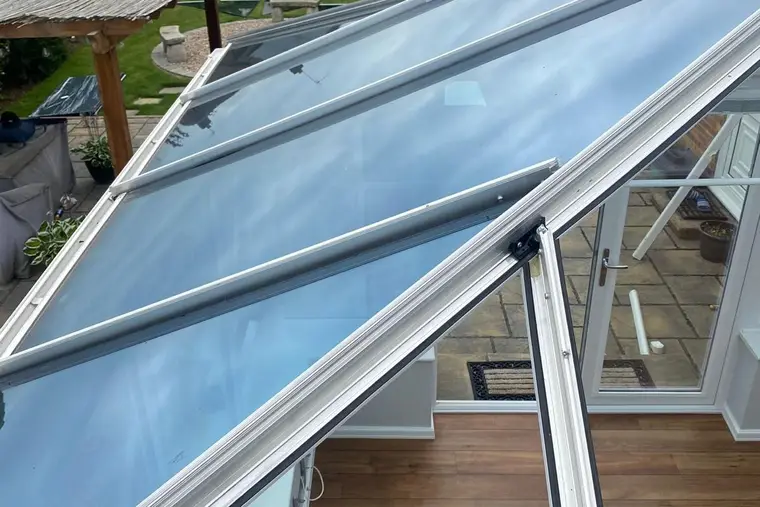
At Number 14 the glazing bars stay. The old sheets lift out, our made to measure panels drop into the same bars, and fresh caps and gaskets lock each one in. Nothing structural is rebuilt.
Plastering and decorating
A tiled roof needs a ceiling underneath it. At Number 12 that means plasterboard, a skim coat, drying time and then paint. It brings a second trade into the house and keeps the room shut while the plaster dries.
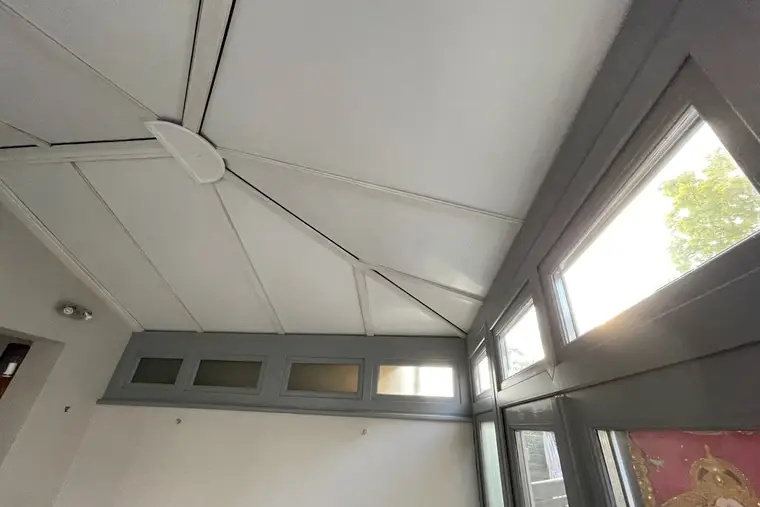
At Number 14 the underside of each panel is already a smooth white finish. The ceiling is done when the last panel goes in, and spotlights can be fitted the same day.
Days on site
Number 12 should expect 3 to 5 days of work, more on a complicated shape or in a wet week. Every day is two or three people's wages plus site costs, and they all end up in the quote. Number 14's medium roof takes 1 to 2 days. This is the biggest single reason the prices are so far apart.
Scaffold and waste
A tiled roof build usually needs scaffold around the conservatory and a skip on the drive. Published 2026 prices put scaffold hire at around £400 to £800 and a skip at £120 to £300. Number 14 needs neither: most single storey panel roofs are fitted from platforms and ladders, and the old sheets leave on our van for recycling.
Structural checks
Tiles, battens and plaster weigh more than the polycarbonate they replace. Number 12's installer has to check that the window frames, dwarf walls and base can carry the extra load, and building control will want to see that someone has. Where a frame needs strengthening, published prices for the work run at about £3,000 to £4,000 on top.
Panels weigh far less than that stack of tiles and plaster, and most healthy uPVC and aluminium frames carry them without any strengthening. Our surveyor still checks the ridge, bars and walls at Number 14 before anything is ordered.
The winter test: how much warmer is Number 12?
Warmer, yes. Lightweight tiled systems come in at a U-value of roughly 0.15 W/m²K, against roughly 0.43 for the 75 mm panel we fit. We will not pretend otherwise. The useful question is what that difference is worth.
Start with a frosty January evening and a room kept at 20°C. Heat loss in watts is U-value x roof area x the temperature gap, here 20 degrees:
- The old 16 mm polycarbonate at 2.3 loses about 782 W through 17 m² of roof. That is most of a small electric heater going straight out.
- Number 14's panels at 0.43 lose about 146 W.
- Number 12's tiled roof at 0.15 loses about 51 W.
So on that evening the tiled roof holds back about 95 W more than the panels. That is less than a single old-style 100 W light bulb.
Across a whole year, replace the temperature gap with heating degree days (about 2,150 in a typical English year), multiply by 24 hours and divide by 1,000 to get kWh.
| 17 m² roof | kWh escaping per year | Cost if heated by electric | Cost if heated by gas |
|---|---|---|---|
| Old polycarbonate, 16 mm, U 2.3 | 2,018 kWh | £531 | £179 |
| Number 14's panels, U 0.43 | 377 kWh | £99 | £33 |
| Number 12's tiled roof, U 0.15 | 132 kWh | £35 | £12 |
Costs are worked out at the Ofgem cap rates in force from 1 October to 31 December 2026: 26.32p a kWh for electricity, and 7.97p a kWh for gas burned in a 90% efficient boiler.
Going from polycarbonate to panels cuts about 1,640 kWh a year. Going on from panels to tiles saves a further 245 kWh or so. Panels deliver about 87% of the heat saving a tiled roof would, for well under half the price.
In money, Number 12 keeps about £65 a year more than Number 14 on an electric heater, or about £22 on gas. Take a bigger medium roof of 19 m² and the gap is still only about £72 a year on electric.
Now set that against the extra £5,850 to £9,800 Number 12 paid. On electric heating the extra takes roughly 90 to 150 years to earn back. On gas it is more than 250 years. Neither household will live to see it.
Where the tiled roof really does win
A fair comparison says what the dearer option does better. A tiled roof is the right call in a few situations.
- You want it to look like the house. From the garden a tiled roof reads as part of the main building. Panels give a crisp, flat finish in whatever RAL shade you pick, and some people simply prefer the tiled look.
- The frame is failing anyway. If the window frames or dwarf walls need rebuilding whatever happens, you are paying for new structure anyway, so the difference shrinks. We will tell you plainly at the survey if that is where you are.
- The room is heated all day, every day. A room kept at house temperature from morning to night gets more from the lower U-value. The payback is still long.
- Building control insists on 0.15. Approved Document L 2021 sets 0.15 as the figure for a new roof element, and councils take different views on how strictly that applies when a conservatory is converted. Our panel does not reach 0.15, which is why we settle the specification with your council before ordering anything. If they will only accept 0.15, you hear it from us first.
When panels are the better buy
The more common situation looks like Numbers 12 and 14: a sound uPVC frame, a cold and noisy roof, and a room that should be usable all year. For that, panels do most of the job at a fraction of the cost.
- You want the room warm this winter. Panels are usually fitted three to five weeks on from the survey, with 1 to 2 days on site.
- You work from home or have small children, and would rather avoid a week of trades and drying plaster.
- You would like to spend part of the difference elsewhere. Number 14 could add two glazed roof lights (£790 together) plus spotlights for £345, and still sit about £3,900 or more below the cheapest version of Number 12's quote.
The paperwork is the same both ways
The building regulations exemption for conservatories depends on light: three quarters of the roof and half the walls must be see-through. Put any solid roof on, panels or tiles, and that test is failed, so both houses normally need building control sign off. Planning is a different story. Neither roof makes the conservatory bigger or taller, so neither usually needs permission. Check first if your home is listed, sits in a conservation area, a National Landscape or a national park, or has lost its permitted development rights. The Planning Portal covers the detail, and our guide to conservation area roofs explains the extra step.
Comparing your two quotes: an 8 point checklist
If you have a tiled quote and a panel quote on the table, put the same questions to both installers. The answers make the numbers comparable.
- Does the price include taking away the old roof, and is a skip or scaffold charged separately?
- Is plastering and decorating the new ceiling included, or left to you?
- Has the frame been assessed for the new roof's weight, and is any strengthening priced?
- What U-value does the finished roof reach, and how was it worked out?
- Who applies to building control, and who pays the fee?
- How many days on site, and how will the room be kept dry overnight?
- Is the guarantee insurance backed, and how long does it last?
- Which extras, such as roof lights, spotlights and gutters, are in the figure and which are not?
Fill in both columns and, for a sound frame like Number 12's, the panel figure usually comes out below half the tiled one, and nothing that matters has been dropped.
Get your own two numbers
Start with the roof builder for a panel price in about a minute, or read the full price breakdown to see what each part pays for. When you are ready for a fixed figure, send your details through the quote form and a surveyor will arrange a visit. If your current roof is polycarbonate, the polycarbonate replacement page covers the swap in more detail.
Questions
Is a tiled conservatory roof worth twice the price of panels?
For looks, and for a room heated all day, some people decide it is. On heat alone it rarely pays: the extra warmth on a medium roof is worth about £65 to £72 a year on electric heating, against £5,850 to £9,800 more up front.
Does a tiled roof make a conservatory darker than panels do?
About the same. Both are solid roofs, so the daylight comes through the side windows. Glazed roof lights can be added to either to bring back some sky.
Why do tiled conservatory roof quotes vary so much?
Published 2026 prices run from about £6,000 to over £20,000. The spread comes from shape, whether the frame needs strengthening, how much plastering is included and how many days the crew is on site.
Will a tiled roof need planning permission when panels do not?
Usually neither does, since the conservatory keeps its size and height. The same exceptions apply to both: listed homes, conservation areas, National Landscapes, national parks and houses that have lost permitted development rights.
Can insulated panels match the U-value of a tiled roof?
No. A lightweight tiled roof reaches about 0.15 W/m²K, while the 75 mm panel we fit is about 0.43. The difference is real but small in money, as the sums on this page show.