If the door to your conservatory stays shut from the clocks going back until Easter, you are not alone. Plenty of homes have a room they pay for all year and use for five months. Before spending anything, find out why yours is cold. There are four usual suspects, and the fix for one does little for the others.
The four places the warmth goes
- The roof. Thin, large, and exactly where warm air gathers.
- The glazed walls. Old or failed double glazing leaks heat almost as badly as an old roof.
- The floor. Many conservatory bases are a concrete slab with little or no insulation under it.
- Gaps. Worn door seals, a tired join where the roof meets the house, vents stuck open.
A 10 minute test on a cold evening
Run the heater for an hour first so the room is as warm as you normally have it. Then:
- Feel the surfaces. Hold the back of your hand near the roof glazing (from the floor, or a step stool on level ground), then the wall glass, then the floor. The one that feels coldest is losing the most. A cheap infrared thermometer turns this into numbers.
- Hunt the draughts. Hold a strip of tissue paper along the door seals, around opening sashes and along the line where the roof meets the house. Any flutter is a gap.
- Look for cold drips. Water running down the roof bars on a winter morning means the inner surface is well below room temperature.
- Time the cool-down. Note the thermometer reading, switch the heater off, and check again after 30 minutes. A room that drops fast is losing heat through its surfaces, not just its gaps.
Most people find the roof is coldest, but not always. If the wall glass is misted between the panes, those units have failed and are part of the problem too.
A worked example: the 1970s semi
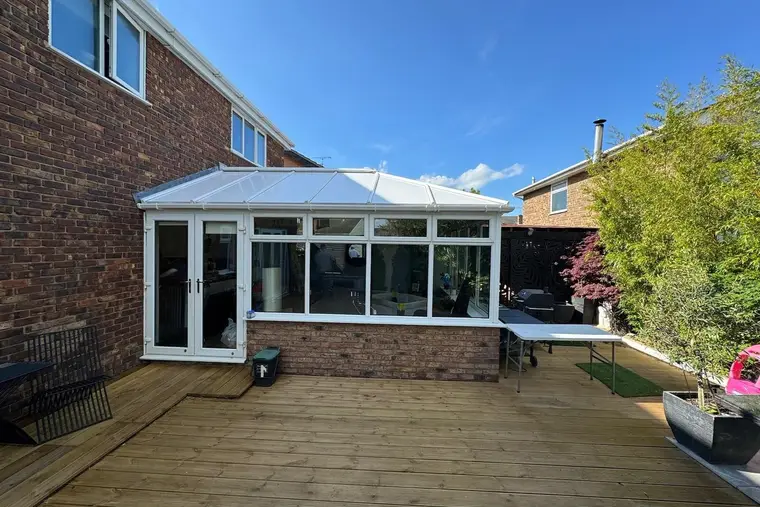
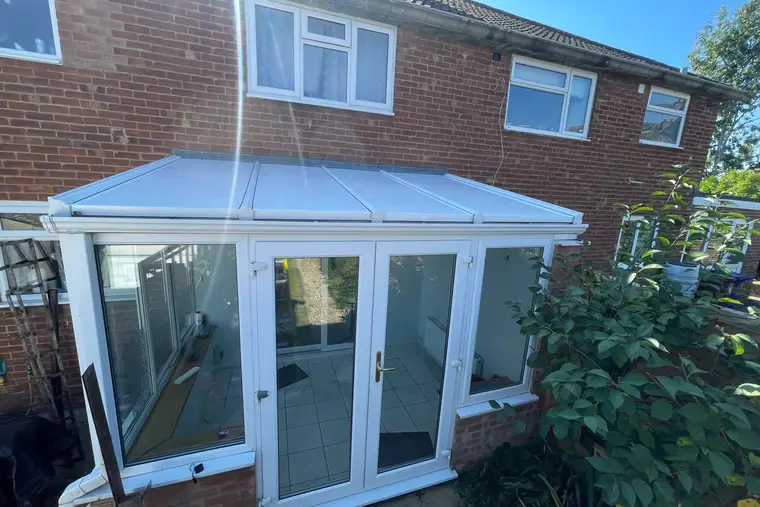
Here is a very common case: a 3.5 m by 3 m lean-to on a 1970s semi, with a 16 mm polycarbonate roof, a 600 mm brick dwarf wall and 2000s double glazing above it. On a 2°C night, heated to 20°C, the gap is 18 degrees.
- Roof: about 10.5 m² at U 2.3 is 2.3 x 10.5 x 18 = about 435 W.
- Glazed walls: about 14.3 m² of glazing at around U 1.8 is about 462 W.
- Total through those two: about 897 W, before the floor, the brick and the draughts.
Swap only the roof for insulated panels at U 0.43 and the roof figure falls to about 81 W. The total through roof and glass drops to about 543 W, a cut of roughly 40%.
That is less dramatic than the 80% cut in roof loss alone, and it is the honest figure. The walls still lose heat. What changes most is how the room feels: warm air no longer pours its heat into a cold ceiling, so the temperature near your head and shoulders stays close to the thermostat reading, and the room holds its warmth after the heater goes off.
Over a whole winter
Using 2,150 degree days, the polycarbonate roof loses about 1,246 kWh a year and the panel roof about 233 kWh. The difference, about 1,013 kWh, is worth around £267 a year on electric heating at 26.32p per kWh, the October to December 2026 cap, if the room is heated through the season. Heat it less and you save less, but you also gain a room you actually want to sit in.
Fixes, cheapest first
| Fix | Rough cost | What it helps | Its limit |
|---|---|---|---|
| New door seals and brush strips | Tens of pounds | Draughts at doors and sashes | Does nothing for the roof or glass |
| Thick rug over a hard floor | Whatever the rug costs | Cold feet, cold floor | Floor heat loss carries on underneath |
| Heater on a thermostat and timer | Under £100 for most plug-in heaters | Stops heating an empty room | The heat still escapes as fast when it is on |
| Thermal blinds on the walls | Varies by size | Wall glass at night | Little effect on the roof; see blinds against a new roof |
| Internal roof insulation | Roughly £1,050 to £2,750 on a 9 m² room, depending on finish | Roof heat loss | Old sheet stays on top; vapour control must be right |
| 35 mm polycarbonate, like for like | Roughly £2,000 to £3,500 on a 9 m² roof | Some roof heat loss (U 1.4) | Loses over three times what a panel roof does |
| Insulated panel roof | £3,000 to £3,550 for a small lean-to, fitted | Roof heat loss, cold ceiling, summer heat | Walls and floor unchanged |
The internal insulation and polycarbonate figures come from published 2026 cost guides. Ours are our own fitted prices, covering removal of the old roof, your colour, the building control application and an insurance backed guarantee for 10 years.
Which fix suits which result
- Tissue flutters, surfaces feel fine: seals and a thermostat first. Cheap and quick.
- Roof coldest, drips on the bars: the roof is the main leak. Look at panels, which also stop most of the drips.
- Wall glass misted between panes: replace those sealed units as well, or the walls will keep dragging the room down.
- Floor ice cold, everything else fair: rugs now, and think about floor insulation if you ever relay the floor.
One point to watch once the room is warmer: warm air holds more moisture, so keep some fresh air coming in. Our guide to conservatory ventilation sets out a simple routine.
When the roof is the answer
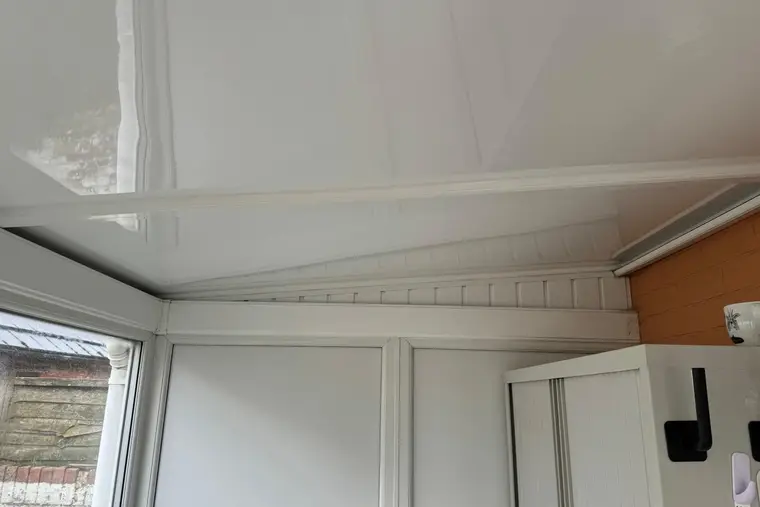
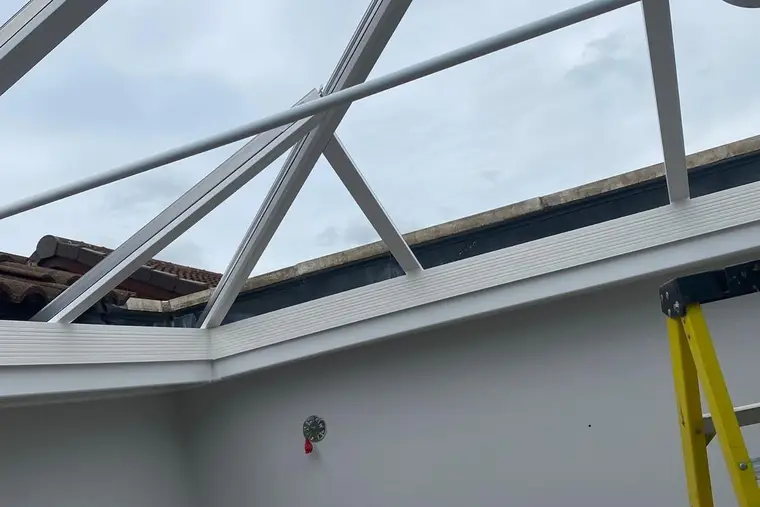
If the test points at the roof: on a small lean-to, panels go on in one day, with a 3 to 5 week lead time. The roof is two aluminium skins with a 75 mm solid foam core, white inside and any colour outside, and it keeps the room cooler in summer as well. See what the change involves on our polycarbonate replacement page, compare sizes on the price guide, or try the build your roof tool. When you have a figure in mind, get my price.
Questions
Why is my conservatory so cold even with the heater on?
Usually the roof. Warm air rises and loses its heat into a thin, cold roof, so the room never feels as warm as the thermostat says.
Will a new roof make my conservatory warm enough to use in winter?
For most homes, yes. A panel roof lets through around a fifth of the heat that 16 mm polycarbonate does, and the room holds its warmth far longer.
Should I fix the walls or the roof first?
Run the 10 minute test. If the roof is coldest, start there; if the wall units are misted between the panes, they need replacing too.
How much does it cost to make a conservatory usable all year?
Draught fixes cost tens of pounds. Fitted panel roofs start at £3,000 (small), £4,000 (medium) or £5,000 (large).