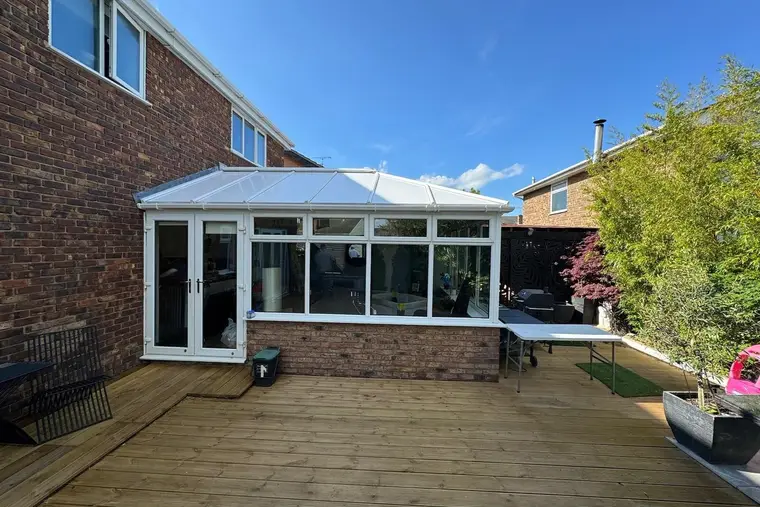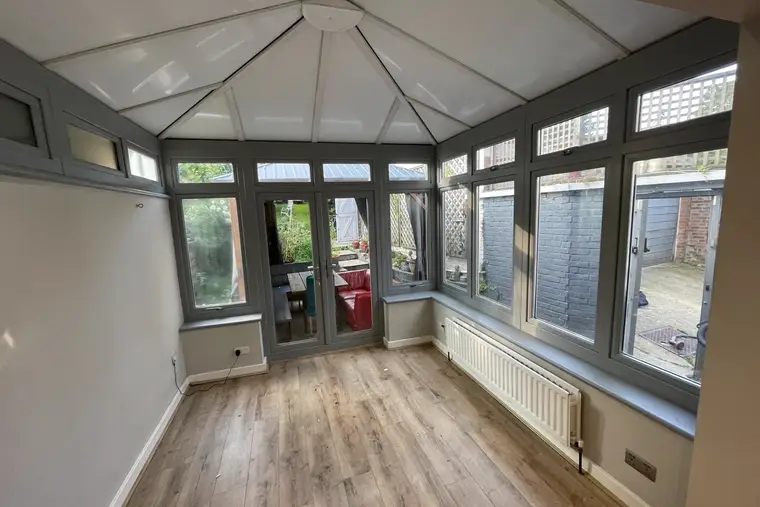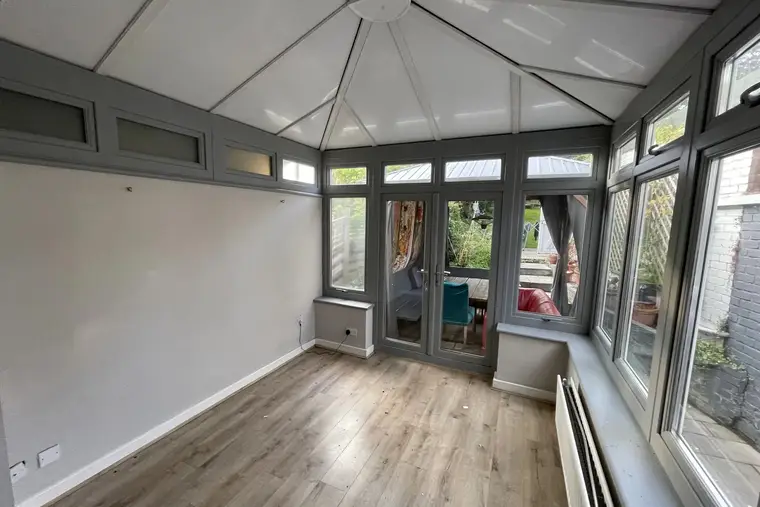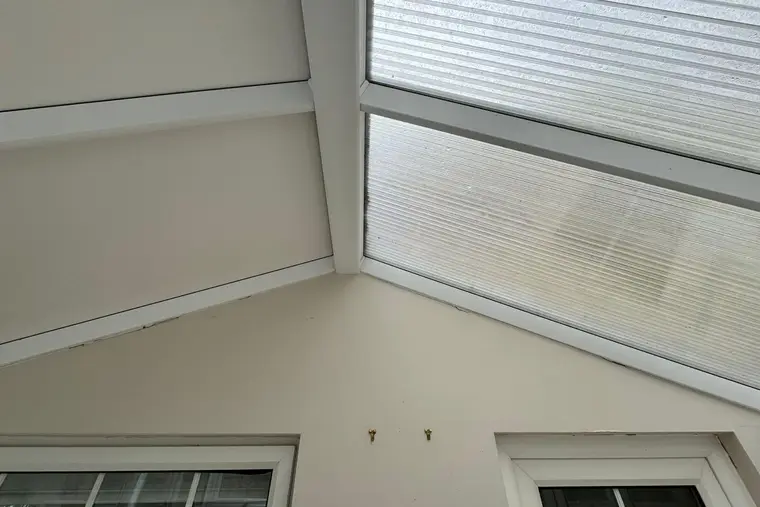
A panel roof asks for very little. There are no flutes to turn green, no end tapes to perish and no glass to streak. What it does need is a clear gutter, a sound seal where it meets the house and a gentle wash now and then. Below is the routine we suggest to every customer, the few things to avoid, and the signs that mean you should pick up the phone.
Which chores go, and which stay
If you have lived with polycarbonate, you know the drill: algae in the channels, grime lines under every glazing bar, a sagging sheet after a windy winter. Most of that stops once the old sheets have gone off to be recycled.
- Gone: scrubbing out flutes, replacing perished end tapes, cleaning roof glass inside and out, fishing leaves out from under the ridge cap.
- Stays: gutters and downpipes, the sealant line along the house wall, any roof lights, and a yearly wash of the outer skin.
- New: nothing. The white inner face needs no more care than a painted ceiling.
A year of care in four short visits
Put these in your calendar once and forget them. Times are for a typical 3.5 m by 3 m lean-to; a large P-shape takes about twice as long.
| When | Job | Time |
|---|---|---|
| March | Wash the outer skin and any roof lights, look along the wall join for split sealant | 40 minutes |
| June | Check the gutter outlet after blossom and seed fall | 10 minutes |
| Late November | Clear the gutters once the trees are bare, flush the downpipe with a bucket of water | 40 minutes |
| After a named storm | Look over the roof from an upstairs window or the garden for branches or debris | 5 minutes |
That is under two hours a year for most homes. If a local window cleaner already visits, many will add the gutter clear for a small extra charge, which saves you the ladder work.
How to wash the roof without harming it
- Choose a dull, dry, still day. Bright sun dries soapy water into smears before you can rinse it.
- Stay off the roof. Use a soft brush on an extending pole from the ground, or a ladder standing on firm ground beside the conservatory. Never rest a ladder on the frame, the gutter or the panels.
- Use warm water and a squirt of washing-up liquid. That lifts the traffic film and bird mess that a panel collects in a year.
- Brush downhill. Work from the ridge or the wall towards the gutter, so dirty water leaves by the route rain takes.
- Rinse with a hose on a soft spray. Aim along the slope, not up under the joints.
- Finish the roof lights with a soft cloth. Glass shows smears that the coloured skin hides.
Things to keep away from the roof: pressure washers pointed at seals or the wall flashing, scouring pads, wire brushes, solvent cleaners and neat bleach. Each one either forces water where it should not go or dulls the colour finish.
Gutters are the real job
A solid roof sends every drop of rain straight to the gutter. Nothing soaks in, nothing drips through. Do the sum for a 3.5 m by 3 m lean-to: 10.5 m² of roof in a town that gets 800 mm of rain a year sheds about 8,400 litres. That water has one exit, so a single clump of leaves over the outlet will send it over the front edge and down your window frames.
The sycamore problem
Take a 4 m by 3 m Edwardian in a garden with a neighbour's sycamore hanging over the fence. The keys come down in October, the leaves follow in November, and by early December the outlet is buried. Clearing it once in late November, then a quick look in March, keeps the water moving all winter. Skip the November clear and the first heavy rain in December will show you why it matters.
Also check where the house roof drains. On many homes, a downpipe from the main roof empties into the conservatory gutter. That gutter then carries far more than its own roof, and it blocks faster. If yours is tired or undersized, new gutters and fascia can go on during the same visit for £295.
Inside the room
The inner face is white and smooth. A damp microfibre cloth takes off cobwebs and dust; that is all it needs. Because the inner skin sits close to room temperature, you should not see water running down it. If you find drips, look at the glazed walls and the room's humidity first, as a room with a tumble dryer or wet washing can mist any cold surface. Our guide to conservatory ventilation covers the fixes.
If you chose roof lights or LED spotlights, wipe the glass and the light rims with the lights switched off and cool. Nothing else to service.
Signs worth a phone call
- Brown marks or drips along the line where the roof meets the house, especially after driving rain.
- Water sheeting down the outside face of the gutter when it is not blocked.
- A dent or crease in a panel after a branch or a fallen object hit it.
- Mist or droplets trapped between the panes of a roof light.
- A gap opening in the sealant along the house wall.
An honest point: aluminium can dent where polycarbonate would crack. A shallow dent is usually cosmetic, but a split in the skin lets water reach the core and needs looking at quickly. Take a photo and send it to us.
Your guarantee and who touches the roof
Your roof is covered by an insurance backed guarantee that runs for 10 years. Keep the paperwork with your house documents. Before anyone fixes a satellite dish bracket, a camera, a trellis or a hanging basket to the roof, the gutter or the wall flashing, speak to us. A single screw through the wrong spot can let water in, and work by someone else on the roof can make a later claim harder to settle. The safest rule is simple: nothing gets fixed to the panels.
Still living with the old roof?
If you are reading this while scrubbing green flutes for the third spring in a row, compare the effort. On a small lean-to, panels cost from £3,000 fitted, go on in one day, and turns a twice yearly scrub into a yearly rinse. See what changes on our polycarbonate replacement page, choose a finish on the build your roof tool, or get my price for a figure based on your own measurements.
Questions
How often should an insulated conservatory roof be washed?
Once a year suits most homes. Twice a year makes sense under trees or beside a busy road, where grime and sap build up faster.
Can I use a pressure washer on my conservatory roof?
Keep it well away from seals, joints and the wall flashing. A hose on a soft spray and a long-handled brush clean the panels without forcing water where it should not go.
Do roof panels go green like polycarbonate?
They have no open channels for algae to grow in, so any film sits on the surface and rinses off with the yearly wash.
Can I stand on the panels to reach the gutter?
No. Work from a ladder on firm ground beside the conservatory, and never lean the ladder on the frame, gutter or roof.